How to Do a Barbell Hip Thrust
The hip thrust is a loadable hip-extension exercise. Good technique is less about forcing the bar as high as possible and more about reaching full hip extension while the trunk, feet, and bench remain stable.
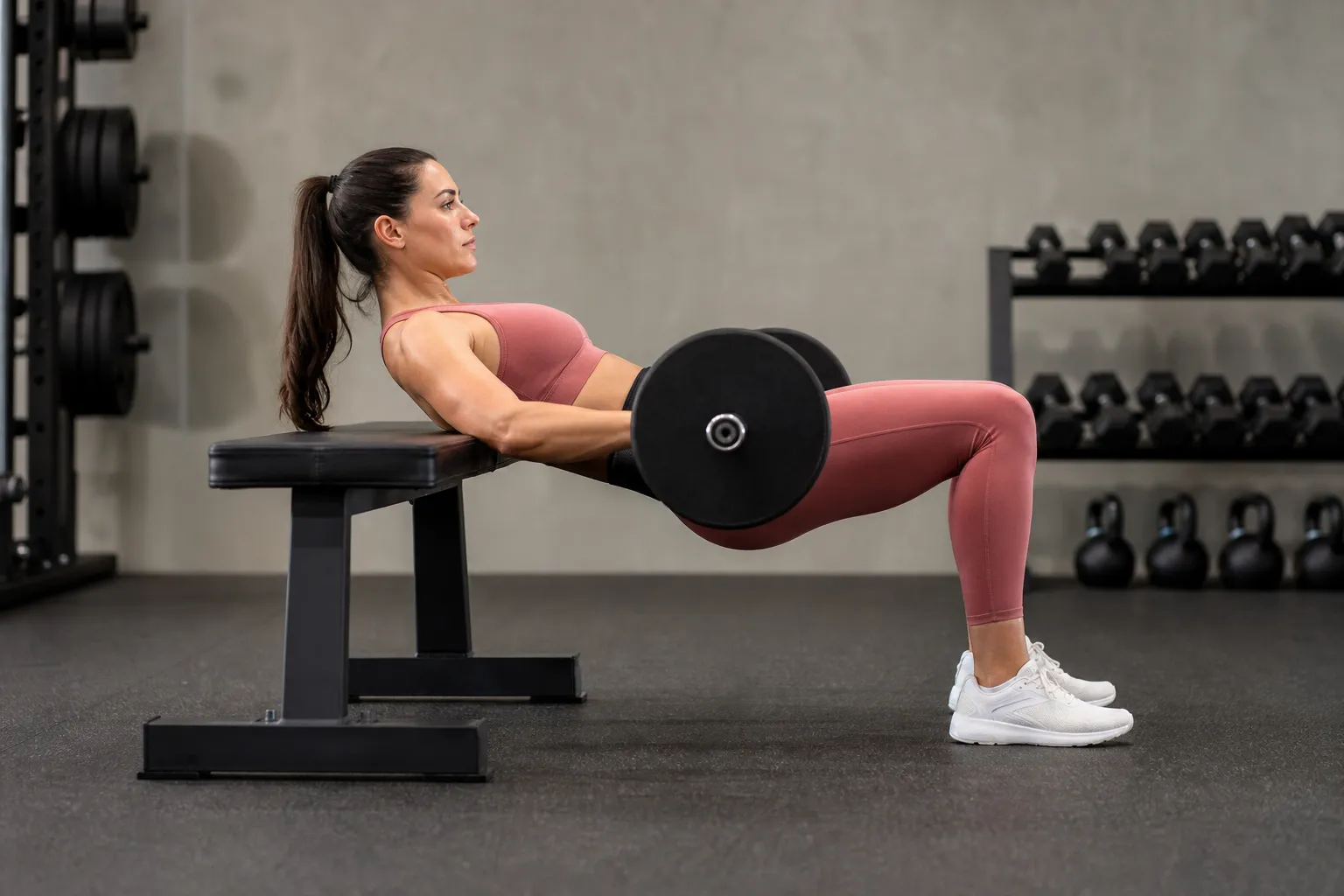
How to do it
- 1
Set the bench and bar
Use a stable bench that will not slide. Pad the bar and position it across the hip crease rather than the abdomen.
- 2
Place your upper back
Rest the lower edge of the shoulder blades against the bench. Your torso should be able to pivot around that contact point.
- 3
Find your foot position
Start around hip-to-shoulder width. At the top, aim for roughly vertical shins while keeping the whole foot planted.
- 4
Brace before lifting
Bring the ribs down, keep the chin gently tucked, and create tension through the trunk before driving through the feet.
- 5
Extend the hips
Lift until the hips reach full extension and the torso is approximately level. Pause without forcing extra height from the lower back.
- 6
Lower under control
Let the hips descend while keeping the bar centered and the knees tracking with the feet. Reset your brace before the next rep.
Common mistakes and fixes
Arching to create a higher lockout
Fix: Finish when the hips are extended and the ribs remain down. More height is not useful if it comes from the lower back.
Feet too close or too far away
Fix: Adjust until the shins are near vertical at the top and you can keep heels and toes grounded.
The bench or body slides
Fix: Use a bench against a rack or wall, reduce the load, and confirm that your shoes and floor provide traction.
The bar sits on the abdomen
Fix: Move the padded bar into the hip crease and hold it steady with both hands throughout the set.
Regressions and variations
Floor glute bridge
The simplest way to learn hip extension with a stable upper body and shorter range.
Dumbbell hip thrust
Easier to set up and load gradually before moving to a barbell.
Banded hip thrust
Adds resistance without requiring a rack, plates, or heavy equipment.
Hip-thrust machine
Reduces bar setup time and can make loading simpler in a commercial gym.
Programming starting points
For general strength and muscle building, start with 2–3 working sets of 8–12 controlled reps once or twice per week. Leave two or three good reps available while learning the movement, then add reps or load gradually.
Frequently asked questions
How high should the bench be for hip thrusts?
A standard flat bench works for many people, but torso and leg length matter. The useful setup is one that supports the lower shoulder blades, stays stable, and lets you reach the floor and full hip extension comfortably.
Where should I feel a hip thrust?
The glutes should produce most of the hip-extension effort, but some hamstring, quadriceps, and trunk involvement is normal. Sharp back, hip, or knee pain is not a target sensation.
Are hip thrusts better than squats?
They emphasize different positions. A volume-matched 2023 study found similar glute growth from hip-thrust and squat programs in untrained adults, while squats produced more thigh growth. They can complement rather than replace each other.
What can I do instead of a barbell hip thrust?
A floor bridge, dumbbell hip thrust, resistance-band hip thrust, or dedicated machine trains the same basic hip-extension pattern with different loading options.
Sources
- Hip thrust and back squat training elicit similar gluteus muscle hypertrophy — Frontiers in Physiology / PubMed (accessed August 2026)
- The impact of resistance training on gluteus maximus hypertrophy — Frontiers in Physiology / PubMed (accessed August 2026)
- Barbell Hip Thrust, Muscular Activation and Performance: A Systematic Review — Journal of Sports Science & Medicine / PubMed (accessed August 2026)