How to Do a Glute Bridge
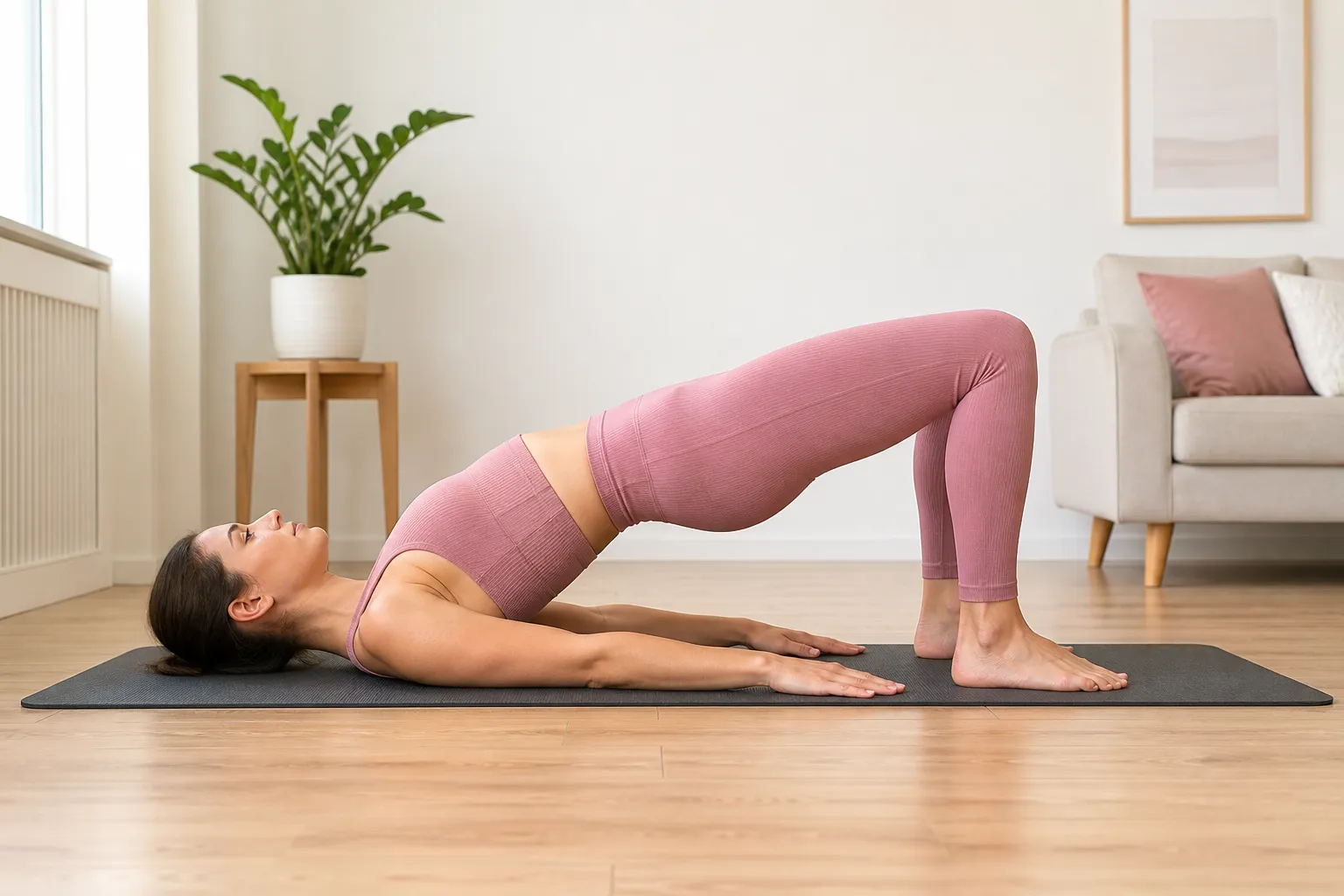
The floor glute bridge is an accessible way to practice hip extension with minimal equipment. It works well as a beginner exercise, warm-up, or home-training movement when every repetition stays controlled.
How to do it
- 1
Set up on the floor
Lie on your back with knees bent and feet flat around hip width. Rest the arms where they help you stay stable.
- 2
Find your foot position
Bring the heels close enough that you can keep the whole foot planted without crowding the knees.
- 3
Brace gently
Keep the ribs and pelvis controlled before lifting. Avoid forcing the lower back flat or holding your breath.
- 4
Lift the hips
Press through both feet and extend the hips until the thighs and torso form a comfortable line.
- 5
Pause and lower
Briefly hold the top without arching, then lower the hips under control and reset.
Common mistakes and fixes
Overarching at the top
Fix: Stop when the hips are extended and the ribs remain down rather than chasing extra height.
Feet slide or lift
Fix: Use a grippy surface and keep pressure through the heel, base of the big toe, and base of the little toe.
Knees collapse inward
Fix: Keep the knees tracking with the feet and reduce the range if that position is difficult to hold.
Pushing through the neck
Fix: Keep the head, shoulders, and upper back relaxed on the floor; the legs should drive the lift.
Regressions and progressions
Short-range bridge
Use a comfortable partial range while learning control.
Paused bridge
Hold the top for two or three seconds without arching.
Banded bridge
Place a loop above the knees and maintain gentle outward tension.
Single-leg bridge
Progress only when you can keep the pelvis level.
Programming starting points
Begin with 2–3 sets of 10–15 reps two or three times per week. When 15 controlled reps feel comfortable, add a pause or progress the resistance instead of moving faster.
Frequently asked questions
Where should I feel a glute bridge?
The glutes should provide much of the effort, with some hamstring and trunk work also normal. Move the feet slightly if cramping or joint discomfort limits you.
How high should I lift?
Lift until the hips reach a comfortable extended position while the ribs and pelvis stay controlled. More height is not better if it comes from the lower back.
How is a glute bridge different from a hip thrust?
A bridge keeps the upper back on the floor and uses a shorter range. A hip thrust elevates the upper back, allowing the hips to travel farther and usually making external loading easier.
How can I make bridges harder?
Add repetitions, pause longer at the top, use a resistance band, add a safely positioned weight, or progress to a single-leg version.
Sources
- Hip thrust and back squat training elicit similar gluteus muscle hypertrophy — Frontiers in Physiology / PubMed (accessed August 2026)
- The impact of resistance training on gluteus maximus hypertrophy — Frontiers in Physiology / PubMed (accessed August 2026)
- Resistance Training Prescription for Muscle Function, Hypertrophy, and Physical Performance in Healthy Adults — American College of Sports Medicine / PubMed (accessed August 2026)