How to Do a Cable Glute Kickback
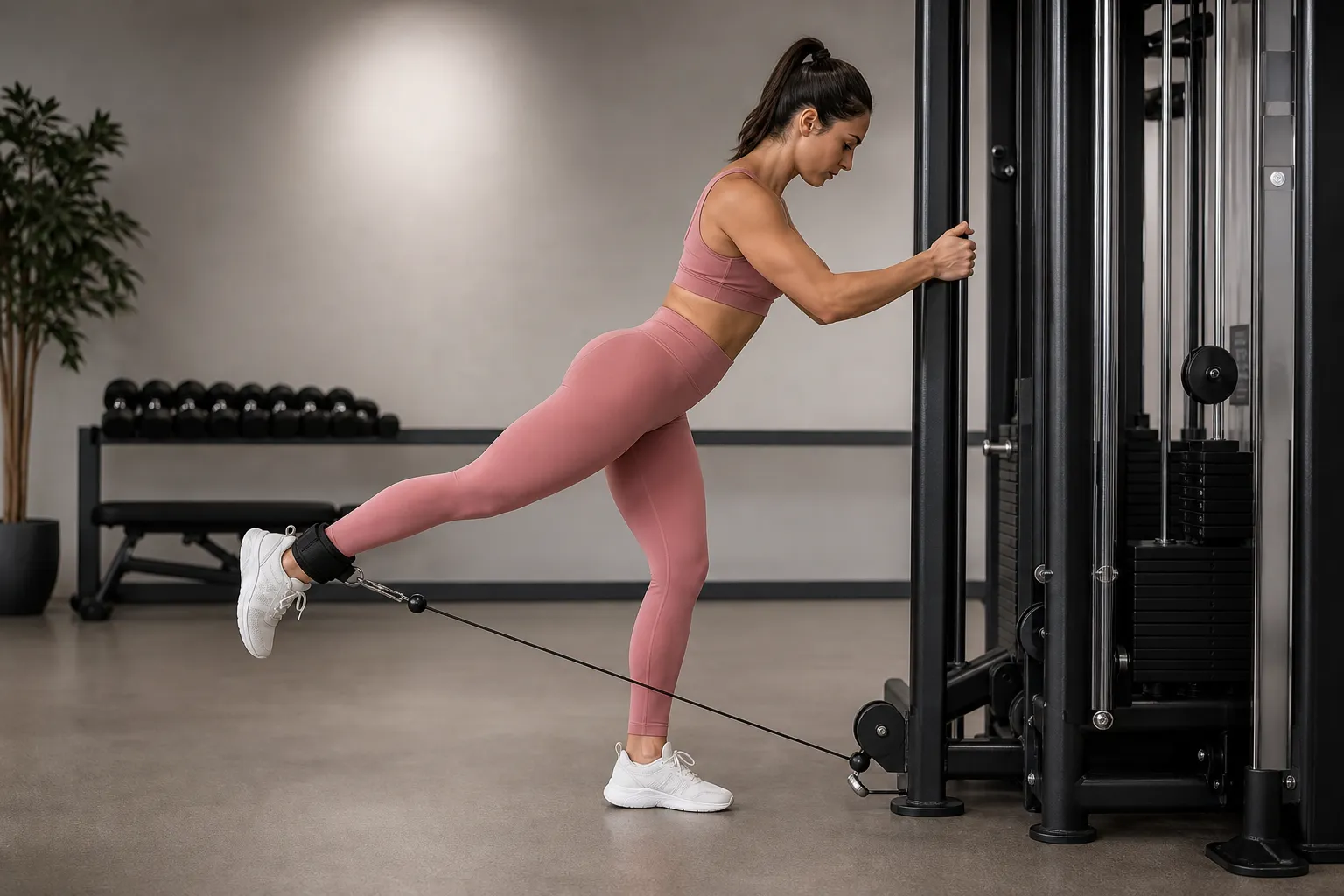
The cable kickback is a supported hip-extension exercise that makes it easy to train one side at a time. Light, controlled repetitions keep the target at the hip instead of turning the exercise into a full-body swing.
How to do it
- 1
Set the cable low
Attach an ankle cuff to the lowest pulley and begin with a light load. Face the machine and hold it for balance.
- 2
Create a stable stance
Stand tall or hinge slightly with the working leg free to move. Keep a soft bend in the supporting knee.
- 3
Brace the trunk
Square the hips toward the machine and gently brace so the lower back does not create the movement.
- 4
Extend the hip
Move the working thigh behind you with a mostly steady knee. Stop before the pelvis rotates or the back arches.
- 5
Return slowly
Control the cable forward without letting the weight stack pull you out of position.
Common mistakes and fixes
Swinging a heavy weight
Fix: Reduce the load and pause briefly at the back of each controlled repetition.
Arching the lower back
Fix: Keep the ribs stacked over the pelvis and use a smaller range of hip extension.
Opening the hip to the side
Fix: Keep both hip bones facing the machine unless you intentionally choose a diagonal variation.
Turning it into a knee curl
Fix: Hold a consistent knee angle and move the whole thigh backward from the hip.
Regressions and variations
Bodyweight kickback
Learn to move the hip without rotating the pelvis.
Banded kickback
Use a low anchor when a cable station is unavailable.
Diagonal kickback
Move slightly outward while keeping the torso quiet.
Kickback machine
A fixed pad can simplify setup and loading.
Programming starting points
Use 2–3 sets of 10–15 controlled reps per side near the end of a lower-body workout. Increase reps within the range before selecting the next small weight-stack increment.
Frequently asked questions
How far should I kick back?
Only as far as the hip can extend while the pelvis and lower back remain steady. A small controlled range is usually more useful than a high swing.
Should my leg stay straight?
A straight or softly bent knee can work. Keep the chosen angle consistent so the movement comes primarily from the hip.
Why do I feel my standing leg?
The standing leg stabilizes your body. Use hand support, reduce the load, and take enough rest if balance becomes the main challenge.
Can resistance bands replace a cable?
Yes. A low-anchored band offers a similar movement, although its resistance increases more sharply as it stretches.
Sources
- The impact of resistance training on gluteus maximus hypertrophy — Frontiers in Physiology / PubMed (accessed August 2026)
- Resistance Training Prescription for Muscle Function, Hypertrophy, and Physical Performance in Healthy Adults — American College of Sports Medicine / PubMed (accessed August 2026)